


Indigenous solutions: our past and our future
ZWA is committed to upholding Te Tiriti o Waitangi and He Whakaputanga o te Rangatiratanga o Nu Tireni. We believe that supporting Indigenous self-determination and kaitiakitanga are essential to addressing the root causes of the waste and climate crises, and to building a truly just and regenerative zero-waste future. We understand that the waste and climate crises are symptoms of a linear, extractive economic system that disregards both the natural world and Indigenous rights.
Yet the links explaining how colonialism has created the waste crisis are not always as clear as they could be. By extension, the profound solutions offered by decolonial and Te Tiriti-honouring zero waste approaches are often minimised.
Zero waste is not a new idea. It has very little to do with personally buying our way out of creating waste. And the desire for a beautiful, healthy and thriving world certainly isn’t limited to any one group of people. Instead zero waste is both a challenge to, and a solution for, the current way of doing things that wastes both people and valuable resources.
To realise that means going to the roots of the problem: economic settings, political power and cultural assumptions.
L’Rey Renata offers a view of waste from a Te Ao Māori perspective
It’s the system
We can all see that the way things are is not working for lots of people, most people, in fact, as the cost of living soars and the standard of living falls. Aotearoa New Zealand, once a global leader in building high quality state houses now has an exploding homeless population, along with 500,000 people regularly reliant on food banks, some of the world’s highest rates of suicide, and widespread mental and physical illness. We can see the waste piling up, our water polluted so badly it is causing cancer and deaths, while everyday the extreme pressures on our native ecosystems and climate grow.
These facts on the ground are not, as some would like you to believe, abnormal ‘crises’. Instead, these are the inevitable outcomes of systems set up to exploit resources and to erase people who stand in the way of doing so. If allowed to continue they will consume the earth and lay waste to our amazing human potential and beautiful world.
But it does not have to be this way. There are viable alternatives.
Zero waste is the endpoint: recognising injustice is the starting point
‘Waste’, better understood as how we deal with materials and resources once we are ‘done’ using them, is full of assumptions that are both culturally specific and deeply damaging.
In our society, we have decided it is acceptable to create significant social and environmental harm in order to extract resources (like fossil fuels, rare metals etc) and to produce products (like plastics). The reasoning is that the products are beneficial and enhance our standard of living. Yet the harm of extraction on a global scale is almost always borne most heavily by indigenous peoples and communities of colour while the benefits are disproportionately enjoyed by wealthy white communities. This is also specifically true in Aotearoa NZ.
Taranaki: creating a wasteland?
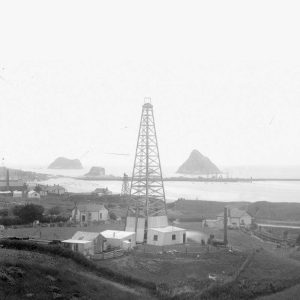
In Aotearoa NZ the first oil well in the British Empire was established in Taranaki in 1865, coming close on the back of the confiscation of 1.2 million acres of Māori land in Taranaki in January of that same year. This started the fossil fuel industry that has spread across Taranaki both onshore and offshore contaminating the climate, land and water.
The war that was waged against Taranaki Māori was one of grotesque war crimes including rape, and employed “scorched earth” tactics which destroyed homes, villages, cultivations, and food-stores. Taranaki Māori leaders were imprisoned and put to work doing hard labour building Dunedin’s roads, seawalls and causeways. This pacification of the indigenous population, and the legalised theft of land, opened up vast resource stores for exploitation.
About $600 million of export earnings come from Taranaki’s oil and gas fields every single year: fossil fuels that underpin the even more lucrative dairy industry with urea fertiliser, fossil fuels that are the basis of the plastic industry; fossil fuels that are driving the climate breakdown. Meanwhile, the dumping of drilling waste, euphemistically called ‘land farming’, has contaminated land across the region.
Then having carried out all this damage in extraction, production, distribution and consumption, we have further decided that it is acceptable to simply throw those resources ‘away’, usually into a hole in the ground, when we no longer want or need these materials where they will create further harms including leachate, methane emissions and microplastic pollution.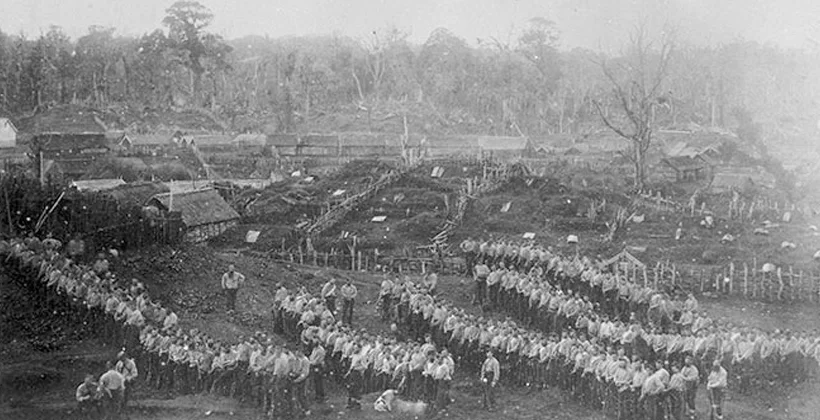
Colonial troops invading the Taranaki Māori settlement of Parihaka, 5 November 1881.
The idea of ‘away’
These holes in the ground where we throw all our stuff away are most often located on land taken from Māori under the Public Works Act.
The idea that there is some place where it is acceptable to dump waste and contaminate the ground arrived with settlers, along with practices that made cities like Dunedin, Christchurch Auckland and Wellington awash with sewerage, disease and waste in the water and the streets.
Te Ara/Encyclopedia of NZ notes
A lack of hygienic care around waste and water was typical of urban society in both Europe and New Zealand in the mid-1800s. This was made worse by politics and corruption. Provincial governments fairly quickly devolved responsibility for municipal administration to town boards, but did not provide adequate funding for clean water supplies and other sanitary facilities.
By contrast, Māori had highly developed methods of dealing with waste, including human waste. This is part of tikanga developed over centuries to limit sickness, disease and food contamination.
Again Te Ara/Encyclopedia of NZ tells us that sanitary arrangements included:
- special sites for rubbish disposal, with designated people to ensure waste was put there
- purpose-built latrines where excrement was not allowed to build up
- raised and sealed storehouses to keep food free of contamination
- purpose-built houses for giving birth or dying, which were destroyed immediately after use.
Māori also had a system of identifying and regulating the use of different grades of water, from most pure to least pure. Used water was always disposed of on land, not into another body of water.
By the time of the first landfill survey in 1971, there were 560 sites identified, most were just open pits operating with no environmental controls.
Even very contemporary attempts at waste minimisation can replicate the harms of colonisation. Underlying injustices remain unaddressed and decision-makers fail to grasp that ‘away’ does not just mean a bounded physical space, but the whole of the receiving environment.
Feilding/Aorangi: Te hau para
In 2018, the Manawatu District Council built a new resource recovery facility on land subject to an existing Treaty claim by Ngāti Kauwhata. The council then secretly ‘grandfathered’ consent for a waste-to-energy pyrolysis plant on to the existing land use consent which they claimed would deal with only the ‘residual waste’. Meanwhile the pyrolysis company did a ‘hard sell’ to the iwi about the amazing economic benefits it would bring.
Little information was provided to iwi about the dioxin, heavy metals and acid gases that would be emitted. Aorangi marae is just 500m down the road. Esteemed Massey University professor and hapū member Dr Meihana Durie subsequently outlined four major projects that were already impacting air quality which his hapū had never been consulted on. He went on to note at the Regional Council air quality consent hearing that:
As Mana Whenua, our kaupapa, our purpose, is to protect the Aorangi, or skies above us, and the Hautapu, or sacred winds and airways, around us. The prospect of pyrolysis is a frightening one for our people, it threatens to destabilise our commitment to the kaupapa of our ancestral home Aorangi, and threatens to diminish our collective capacity to practice Kaitiakitanga, or environmental stewardship.
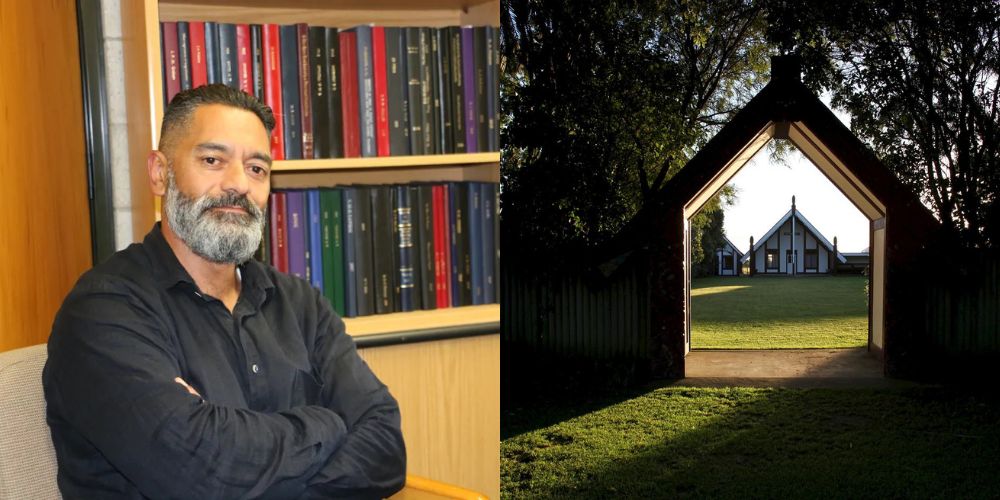
Professor Meihana Durie and Aorangi Marae
Needless to say, for Tangata Whenua – literally ‘people of the land’ – there is no land that is ‘away’. They are part of the land, part of the environment, and it is part of them. The language of colonisation has allowed some lands to be declared ‘wastelands’ – and therefore ripe for taking and using by settlers as Māori were not deemed to be using them properly. This represents not just a theft of property, but of the very being of Māori.
‘Away’ over there
Today, Aotearoa NZ produces some 17 million tonnes of ‘waste’ each year with almost 10% of that being sent ‘away’ overseas to Malaysia and Indonesia where they are illegally dumped or burned and contaminate other, non-Western, communities.
Central government has recognised that ‘New Zealand cannot deal with all our plastic waste onshore due to infrastructure constraints’ and that, ‘There is evidence that there is poor compliance and enforcement of laws in developing countries, coupled with limited resources and poor waste management infrastructure, resulting in waste being dumped or incinerated rather than recycled.’
There are deeply racist cultural assumptions and powerful economic forces that have created the situation where non-white, non-Western societies have become the recipients of the world’s waste, much of this mirroring patterns of colonialism going back centuries. This is called ‘waste colonialism’. Aotearoa researchers Matt Peryman, Romilly Cumming, Tina Ngata et al. write:
“…colonial governmental and economic systems have enabled a widespread disconnection between plastic consumption and its socio-ecological consequences. Plastic pollution as waste colonialism also perpetuates significant inequities for Aotearoa’s most disenfranchised communities, including Māori, Pasifika, and low-income households.”
Needless to say, waste and colonisation are intimately linked – not simply as a historical event, but as an ongoing process whereby those with power decide who owns resources, how resources are used, who benefits from them, where they go when they are finished with them, and who pays for the damage of using these resources.
Real indigenous solutions, not more toxic pollution
Understanding that colonisation is the root of our waste problem is a wonderful gift, because it shows us an answer to the problem: decolonisation.
Decolonisation is a big word with a wide range of meanings in different contexts and for different people. Without delving too far into these, it can be useful to conceptualise decolonisation here in Aotearoa as described by Ocean Ripeka Mercer as ‘underpinned by a commitment to making co-habitation work’.
Furthermore, she says, ‘It doesn’t necessitate the wholesale withdrawal of “the coloniser”, but does require that power imbalances are addressed, that negative effects of colonisation are peeled away and that pre-colonial ways are revived – often starting with language, education and social practices or tikanga.’
The process of decolonisation is evident everywhere you look in the Māori world: it is the assertion of power and control by Māōri over their lives, their lands, resources and culture. For Māori, it is also a process of re-indiginisation: not simply undoing the harm of colonialism, but rebuilding, reclaiming and reinventing Māori ways of doing things.
For those of us who are not Māori, we can be a vitally important part of decolonisation. By holding firm to the view that in order to address contemporary problems in Aotearoa NZ we must include Māori, centre their concerns and prioritise their solutions, we can be part of shifting organisational and institutional frameworks and resources as well as cultural beliefs and predispositions.
By extension, that means we must work to actively de-centre existing colonial frameworks and priorities, hand over control and resources to Māori, and to get in behind their solutions. It also means recognising that the existing structures are not fit for purpose.
Matike Mai Aotearoa
The report of Matike Mai Aotearoa (the Independent Working Group on Constitutional Transformation) is a great basis for furthering the discussion about Te Tiriti and what it means for us in Aotearoa today and into the future. That report suggests key values and provides potential models that could be the basis for a Te Tiriti-honouring future.
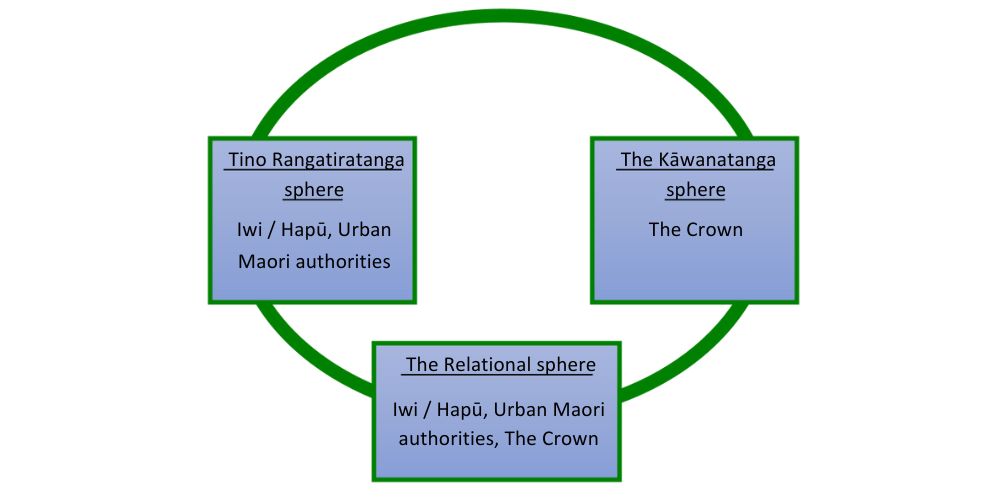
One of the governance models offered in Matike Mai that would move us from just a unicameral parliamentary system
Real examples: Te Tiriti & decolonisation in action
Tangata whenua are leading projects right now to address waste and climate change, and partnering with Tiriti allies to have meaningful impacts for communities.
Para Kore
He mea whakatū a Para Kore i te tau 2010, ko te hononga whakapapa ki a Papatūānuku tōna mātāpono matua. Established in 2010, Para Kore is an Aotearoa-wide Māori, not-for-profit organisation with a kaupapa based on whakapapa to Papatūānuku. ‘Para Kore’ means ‘zero waste’ in Te Reo Māori.
They educate and advocate from a Māori worldview for zero carbon, zero waste whānau, hapū, iwi and hapori Māori. Para Kore supports resilience within Māori communities through mātauranga Māori behaviour change programmes and services.
Onehunga CRC
Onehunga CRC (OCRC) is the first Māori/Pasifika-led Community Recycling Centre in Tāmaki Makaurau. The commercial arm of Zero Waste Aotearoa, Localised, is 50/50 partners with Synergy Projects Community Trust in OCRC.
Operating as a primary hub for collecting resources, OCRC sells reusable materials in the Reuse Shop and repurpose furniture and construction materials for reuse, diverting over 1000 tonnes per year.
Whakahaumanu a Hineahuone
Whakahaumanu a Hineahuone is a joint project between Para Kore, Te Waka Kai Ora, the Aotearoa Composters Network and Zero Waste Aotearoa.
It is a two-year Tiriti-dynamic project supporting small and medium-scale composting initiatives to make mauri-rich compost to enrich local soil and food sovereignty initiatives.
What is Tiriti-dynamic?
A Tiriti-dynamic approach includes centering, respecting and protecting tikanga Māori and mātauranga Māori, and seeing both as taiao-informed. It also means providing opportunities for learning about and connecting with Whenua, Atua and Taiao.
This learning should take a tikanga Māori and Māori-led approach and value Māori ways of knowing and being in the world. It’s also important that this learning takes place in relationship with one another and the whenua. The three key pou of Whakahaumanu a Hineahuone provide the groundwork from which we will communicate and work in a Tiriti-dynamic way. Read more about the approach>>
What is food sovereignty?
Food sovereignty is about protecting the right of Māori and all New Zealanders to eat healthy food from the land, waterways and oceans of Aotearoa New Zealand. In order to do this, Māori must have control over their own ability to produce kai.
The project aims to heal both people and the planet at the same time. It keeps valuable organic materials in use, rebuilding degraded landscapes, and keeps it out of landfill where it creates methane. At the same time, it empowers local whānau, hapū and iwi on their own lands to build food systems that meet their own needs.
It’s a win-win-win for everyone. It is solving many problems at once with Māori-led solutions.
Partnership: Helensville Zero Waste supporting Te Awaroa Kaipara
A significant new project to enable locals and visitors to Helensville to learn about local Māori history is underway. It is a passion project for Helensville Zero Waste (HZW) manager Treena Gowthorpe, who is working closely with the organisation’s kaumātua and cultural advisor Richard Nahi.
The project is designed as a walkway with four key discovery areas on raised land behind The Everything Shop at HZW’s Mill Road site, overlooking the Kaipara River.
HZW is developing the site as “a cultural and historical site that acknowledges and celebrates the stories of tribal life in Te Awaroa.” Richard has named the project Te Hau Hono i Te Awaroa Kaipara – which translates as ‘The winds we feel that bind us together in Te Awaroa Kaipara’.
He says the name acknowledges the “invisible energy and positive power of the wind. Tawhirimatea, the god of the wind, helped navigate us to these lands.” The space will combine historical storytelling, practical knowledge sharing by local tribal representatives, and visual displays to “guide visitors on a journey of discovery and learning.”
That journey will be divided into four main sections.
First will be Te Waharoa (The Entrance) with a carved entranceway, signage giving an overview outlining Māori settlement in the area, and a map showing the locations of Kaipara marae and some mountain and pā sites.
Visitors will next enter Te Ngahere (The Forest), where a large native log uncovered during excavation work for The Everything Shop will be displayed. An existing young kauri tree growing there will be supplemented with other native trees. Signs will identify each species and explain their uses by Māori, such as rongōa (traditional Māori medicine). Plans for this area include a giant checkers board, where visitors will be able to play checkers – but instead of the traditional black and white checkers pieces, one side will feature native birds and the other native fish, complete with their Māori names.
The third area will be Te Awa (The River), with a large viewing platform overlooking the Kaipara River and surrounding farmland and hills. Visitors will be able to relax on recycled bean bags, and signage will explain the river’s cultural significance to Māori and how it was traditionally used by the community.
The final section will be Te Kai (The Food). A glasshouse built by Joe Ineson will grow seedlings, garden beds will be planted with traditional Māori vegetables, and a garden shed has been built for storing tools and equipment. Three recycled spa pools will be sunk in the ground and used to grow watercress. A seed bank will be established, with seeds for crops like traditional Māori potatoes available for sale, trade, or gifting.
Helensville sculptor Jeff Thompson is creating a giant corrugated iron kete around 3m wide which will be on display. Harekeke (flax) for weaving will be planted around the area. Treena says the kete symbolises the first multi-use bag in New Zealand, aligning perfectly with Zero Waste values.
Resources for building Tiriti partnerships
Groundwork has extensive resources for free download as well as options for specific paid mahi to assist in building relationships. These include:
Ngā Rerenga o Te Tiriti Supporting organisations engaging with the Treaty of Waitangi responds to the aspiration of groups and organisations within the community sector to be more engaged with the Treaty of Waitangi. It brings together many years of practice and reflection by Te Tiriti practitioners, community organisations, and mana whenua. In doing so, it provides guidance, inspiration and sustenance to organisations engaging with the Treaty. You can download a free copy here. The resource includes:
- Nga Rerenga o Te Tiriti: community organisations engaging with the Treaty of Waitangi (PDF)
- Organisational stories: reflections from community organisations on engaging with the Treaty
- Additional resources to guide community organisations in their engagement with the Treaty
Centre for Social Impact Te Tiriti o Waitangi resource page that includes video case studies of organisations building partnerships.