


January is International Zero Waste Month which is a wonderful way to make a fresh start on the New Year. This global event is hosted by GAIA, BFFP and members like Zero Waste Aotearoa. The 2026 theme is Invest in Zero Waste: Mobilising resources to support action and accelerate impact.
Read on to find out what that means in Aotearoa!
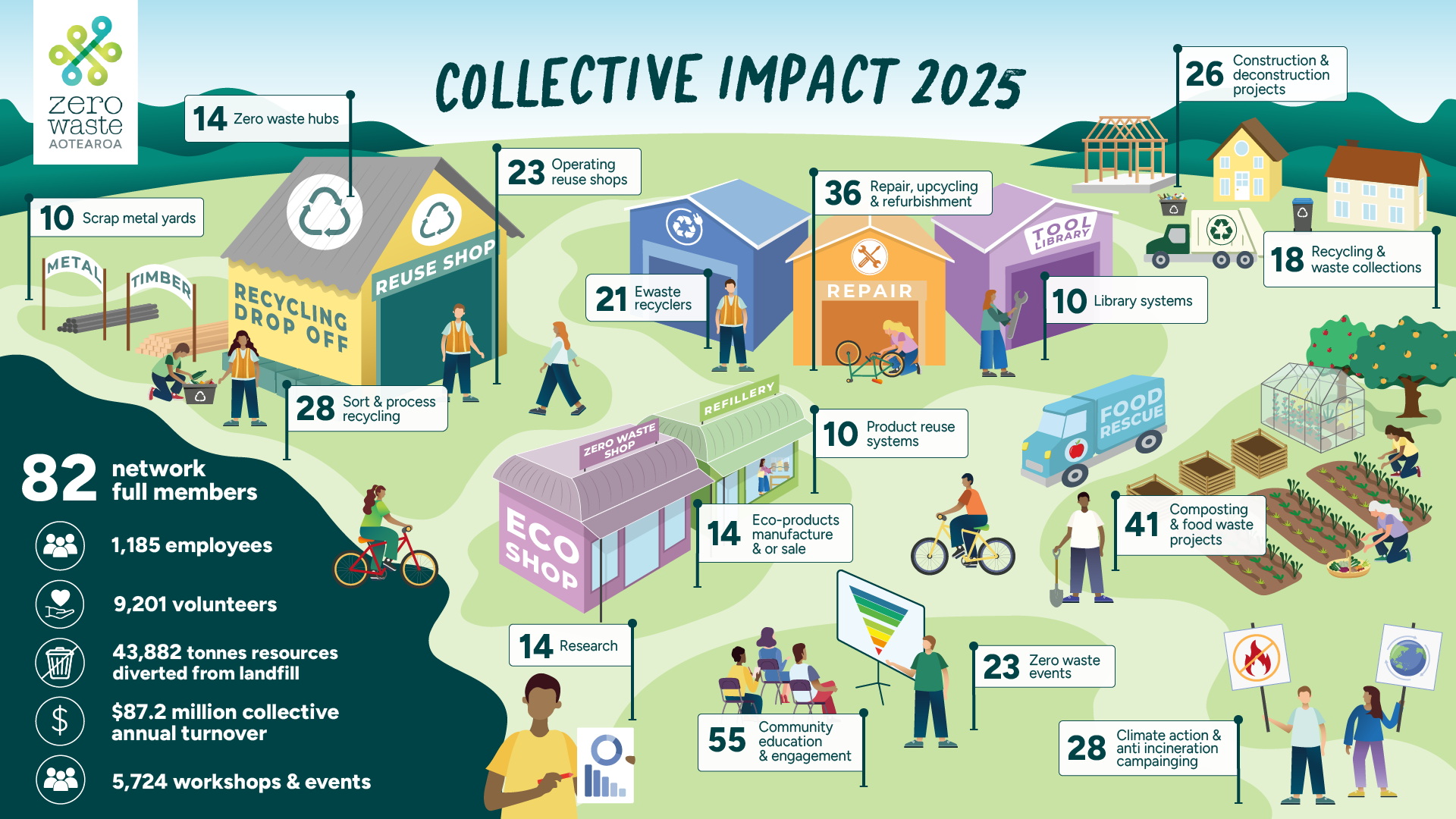
Building the zero waste Aotearoa of tomorrow, today
At Zero Waste Aotearoa, our strength is in our network, a connected movement of community organisations: reusers, recyclers, repairers, composters, educators and innovators all working toward a waste-free future.
We are investing in building a zero waste society today in communities across the country.
This Collective Impact snapshot brings together the shared achievements of our members: the activities they lead, the tonnes of waste they divert, and some of the social and economic benefits they create in communities across the motu.
Together, these stories and numbers show what’s possible when we honour Te Tiriti, uphold local leadership, and collaborate for systems change. Explore the infographic to see the impact we’re creating together.
Zero Waste in Aotearoa
The zero waste movement got its start in Aotearoa way back in 1989 when Warren Snow and Cliff Colquhoun set up the Community Business and Environment Centre. Their Northland community was devastated by job losses caused by the government restructuring and opening up the New Zealand economy in the 1980s.
Warren and Cliff wanted to do business in a way that meant local people could make a living at the same time as they cared for their place and their community. They created new jobs and economic opportunities in recycling, conservation and community services.
All over Aotearoa there are organisations like Xtreme Zero Waste, Wastebusters and Onehunga Zero Waste that have followed in their footsteps. These community-led organisations put business to work for the common good. They channel cash flow and staff time into work that needs to be done. They focus on what makes sense for their local community and its visitors.
Using business as a tool
There are a lot of fancy names for thinking about how business, the environment and society connect up: sustainable business, social enterprise, triple or quadruple bottom line, corporate social responsibility and ESG (environmental, social and governance).
It is considered radical for business to:
- fit into it’s social and environmental context
- think about it’s impacts on our environment and society and
- to behave in a transparent and ethical way.
But communities have been using practical tools for local resource management and economic development for centuries. At its heart is the simple idea that we need to find ways to make a living that leave our places and our people in better shape than they were before. That means putting ‘people and planet’ first, with business in the service of them both. Community-led organisations across the Zero Waste Network use this approach.
Strategic investment
‘Investing in zero waste’ means:
- creating the systems that we need to redesign, repair, reuse and recycle products, packaging and materials, and
- building the infrastructure and revenue flows to deliver those services in communities.
The Infrastructure Commission is focused on getting the right infrastructure in place over the next 30 years. They point out that New Zealand has a long wish list of infrastructure projects. We don’t have much capital to invest. We have limited ability to cover the operational cost for service delivery. We have limited capacity in the engineering, procurement and construction industries. So we need to be smart about which projects we choose to invest in, use demand management tools and find new ways to cover the operational (opex) and capital (capex) costs.
Designing waste and pollution out of products, packaging and business models at the beginning of the supply chain is the top priority for zero waste. If we don’t make and sell unnecessary packaging and short life products in the first place we don’t have to spend time, money and energy trying to deal with them at the end of their very short lives. This is what we mean by demand management.
Infrastructure and services are ‘Best value for money’ when they: meet community needs, improve our environment, reduce emissions, create good jobs and support local economies. We can have our cake and eat it by putting these core concepts at the heart of decision making.
Instead of investing in incinerators and landfills to hide our inefficient use of resources and energy and creating liabilities that have to be mopped up in the future, we can invest in the systems we need to keep products and materials in circulation for as long as possible.
Product stewardship covers capex and opex costs
Product stewardship is the tool that creates the systems and revenue flows we need to fund the reuse and recycling systems that lie at the heart of the circular economy. It is a way of making sure that those who make, sell and buy products and packaging cover the real cost of putting them on the market, which includes reuse, recycling and litter clean ups.
The proposed NZ Container Deposit Return Scheme is a great example of how this works. Schemes like this are already being used in 32 countries to collect drink containers and cover the real cost of recycling. Evidence from around the world shows that they:
- work – doubling recycling rates and halving litter
- are popular – strong support across the political spectrum
- and pay for themselves.
A few cents is built into the price of each drink to cover the real cost of recycling which means every single-use drink bottle, can or carton bought by households or tourists pays its own way through the recycling system. That takes the pressure off councils and ratepayers because they don’t have to keep subsidising the collection and sorting system.
Over time this covers the cost of setting up the infrastructure as well as the collection, handling and transport systems. Local organisations like recycling centers and retailers like supermarkets get paid a handling fee for being a drop off point for empty bottles, cans and cartons. So jobs are created and money flows into local economies.
Consumers pay a deposit (20c proposed for NZ) which they get back when they return the container, if the container is littered whoever picks it up gets the 20c and you can donate your empties to a school, kura, sports club or organisation so they can claim the deposits back.
Waste levy – funding the transition
The Waste Levy is a charge on each tonne of rubbish that gets disposed of. It creates a pool of capital to invest in building waste prevention and reduction infrastructure so we have the systems that households and businesses need in place to stop creating so much waste.
The levy is a ‘polluter pays’ tool. Those creating the rubbish help to pay for the systems we need to reduce rubbish. It’s a medium term strategy for getting the investment capital we need to make the shift from a high waste, high emissions economy to a low waste, low emissions economy. As these waste reduction systems come on stream the amount of rubbish gets lower, the amount paid into the waste disposal levy gets smaller.
Waste Disposal Levy spending by Central Government and Councils should stay ring fenced for waste reduction services and infrastructure so that over time we are all wasting less and paying less as a result. It is essential that a share of the levy goes to smaller, community-based organisations who develop innovative approaches and support local households and businesses to reduce waste.
Government can help
The organisations across the zero waste network are doing what they can to build zero waste communities. The government needs to step up and introduce effective product stewardship schemes like the container deposit return scheme and use the waste disposal levy revenue to invest in the reuse, recycling and composting infrastructure and services that households and businesses need. 2026 is the perfect year for the government to get some runs on the board.